San Luigi Dei Francesi Commissioner Pope for His Art Collection
| The Calling of Saint Matthew | |
|---|---|
| Italian: Vocazione di San Matteo | |
 | |
| Creative person | Caravaggio |
| Year | 1599–1600 |
| Medium | Oil on canvas |
| Dimensions | 322 cm × 340 cm (127 in × 130 in) |
| Location | San Luigi dei Francesi, Rome |
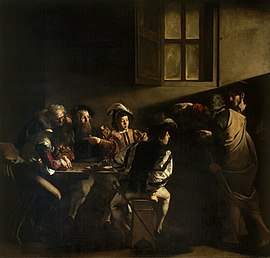
The Calling of Saint Matthew is a painting past Caravaggio, depicting the moment at which Jesus Christ inspires Matthew to follow him. It was completed in 1599–1600 for the Contarelli Chapel in the church of the French congregation, San Luigi dei Francesi in Rome, where information technology remains. It hangs alongside two other paintings of Matthew past Caravaggio, The Martyrdom of Saint Matthew (painted around the same time as the Calling) and The Inspiration of Saint Matthew (1602).
Commission [edit]
Over a decade before, Cardinal Matthieu Cointerel (in Italian, Matteo Contarelli) had left in his will funds and specific instructions for the decoration of a chapel based on themes related to his namesake, Saint Matthew. The dome of the chapel was decorated with frescoes by the belatedly Mannerist artist Giuseppe Cesari, Caravaggio's former employer and ane of the most popular painters in Rome at the time. But equally Cesari became decorated with royal and papal patronage, Cardinal Francesco Del Monte, Caravaggio's patron and besides the prefect of the Fabbrica of St Peter'southward (the Vatican office for Church belongings), intervened to obtain for Caravaggio his first major church committee and his starting time painting with more than a scattering of figures.
The Calling hangs contrary The Martyrdom of Saint Matthew. While the Martyrdom was probably the get-go to be started, the Calling was, past report, the get-go to be completed. The commission for these two lateral paintings — the Calling and the Martyrdom — is dated July 1599, and final payment was made in July 1600. Betwixt the 2, at the altar, is The Inspiration of Saint Matthew (1602).
Subject matter [edit]
The painting depicts the story from the Gospel of Matthew (Matthew 9:nine): "Jesus saw a man named Matthew at his seat in the custom firm, and said to him, "Follow me", and Matthew rose and followed Him." Caravaggio depicts Matthew the tax collector sitting at a table with 4 other men. Jesus Christ and Saint Peter have entered the room, and Jesus is pointing at Matthew. A beam of light illuminates the faces of the men at the tabular array who are looking at Jesus Christ.
Identity of Matthew [edit]
There is some contend over which human being in the picture is Saint Matthew, every bit the surprised gesture of the disguised man at the tabular array tin can be read in two means.
Virtually writers on the Calling presume Saint Matthew to be the disguised human, and see him to be pointing at himself, as if to ask "Me?" in response to Christ's summons. This theory is strengthened when one takes into consideration the other two works in this serial, The Inspiration of Saint Matthew, and The Martyrdom of Saint Matthew. The bearded man who models every bit Saint Matthew appears in all three works, with him unequivocally playing the role of Saint Matthew in both the "Inspiration" and the "Martyrdom".
A more recent interpretation proposes that the bearded man is in fact pointing at the fellow at the end of the table, whose head is slumped. In this reading, the disguised human is asking "Him?" in response to Christ'due south summons, and the painting is depicting the moment immediately before a young Matthew raises his head to run across Christ. Other writers depict the painting as deliberately ambiguous.[1]
Identity of Christ [edit]
Some scholars speculate that Jesus is portrayed as the Last Adam or 2nd Adam as titled in the New Attestation. This is displayed in Christ's manus as it reaches out towards Matthew. It is almost a mirrored paradigm of Adam's paw in The Creation of Adam by Michelangelo, the namesake of Caravaggio.[two] Twice in the New Testament, an explicit comparison is made between Jesus and Adam. In Romans 5:12–21, Paul argues that "just as through the disobedience of the i man the many were made sinners, so also through the obedience of the one man the many will be made righteous" (Romans five:xix, NIV). In 1 Corinthians fifteen:22, Paul argues that "as in Adam all die, then in Christ, all will be fabricated alive," while in verse 45 he calls Jesus the "last/ultimate/final Adam".[iii] [ circular reference ]
Style [edit]
The three adjacent Caravaggio canvases in the Contarelli chapel represent a decisive shift from the idealising Mannerism of which Cesari was the last major practitioner, to the newer, more naturalistic and subject-oriented art represented by Caravaggio and Annibale Carracci: they were highly influential in their day.
In some ways, near of the plebeian, virtually life-sized inhabitants of Levi's money table are the equivalent, if not modeled by those persons in other Caravaggio paintings, including Caravaggio's famous secular genre painting of The Cardsharps (1595).
In this painting, the gloom and the canvassed window appears to situate the table indoors. Christ brings the true light to the dark space of the sitting tax-collectors. This painting records the collision of ii worlds — the ineluctable power of the immortal faith, and the mundane, foppish, world of Levi. Jesus spears him with a beam of low-cal, with an apparent effortless hand gesture he exerts an inescapable sublime gravity, with no need for wrenching worldly muscularity. Jesus' bare feet are classical simplicity in contrast with the dandified accountants; being barefoot may too symbolize holiness, as if one is on holy ground. Similarly to his treatment of Paul in the Conversion on the Mode to Damascus, Caravaggio chronicles the moment when a daily routine is interrupted by the miraculous. Around the human being to become Matthew are either the unperceptive or unperturbed bystanders.
Caravaggio'southward audience would have seen the similarity between the gesture of Jesus as he points towards Matthew, and the gesture of God every bit he awakens Adam in Michelangelo's Sistine Chapel. Post-obit the line of Christ's left arm, it seems that Matthew is being invited to follow him into the earth at large. "This clear legibility, then different from many Mannerist paintings, ... accounted for the piece of work'due south enormous popularity."[one] The position of Christ'south manus, however, reflects that of Adam's in the Sistine Chapel; the Church building considered Christ to be the Second Adam. But instead of beingness gifted life, as the first Adam was, Christ is instead the one who bestows it, calling Levi to a new life every bit Matthew.[4]
Responses [edit]
Pope Francis has said that he frequently went to San Luigi every bit a fellow to contemplate the painting. Referring both to Christ's outstretched arm and Matthew's response, Francis said, "This is me, a sinner on whom the Lord has turned his gaze."[5]
Other paintings of the same topic [edit]
In that location are many other early modernistic representations of the calling of Matthew. Two were painted prior to Caravaggio's but it is unlikely that Caravaggio would accept encountered them.[ citation needed ]
- Carpaccio's version in the Accademia in Venice[6]
- Marinus van Reymerswaele's version (1536)[vii]
- Giovanni Lanfranco'due south derivative version (1626–28)[viii]
- Spanish painter Juan de Pareja's version (1661)[9] constitute in the Prado Museum in Madrid.
- Hendrick ter Brugghen[ten]
- Bernardo Strozzi's version (1620) in the Art Museum in Worcester, Massachusetts[xi]
- Other related paintings of cardsharps include the Caravaggisti delineation of Valentin de Boulogne in the National Gallery of Art in Washington D.C.[12]
Further reading [edit]
- Jürgen Müller: Wer ist Matthäus? Eine neue Deutung von Caravaggios ‚Berufung des heiligen Matthäus' aus der Contarelli-Kapelle, in: Kunstgeschichte. Open up Peer Reviewed Periodical, 2021, [2]
References [edit]
- ^ John L. Varriano, Caravaggio: The Fine art of Realism (Penn State Press, 2006), p.111.
- ^ "The Calling of Saint Matthew". Artble.
- ^ Concluding Adam
- ^ Lavin, Irving (1993). "Caravaggio's Calling of St. Matthew: The Identity of the Protagonist". By-Present: Essays on Historicism in Art from Donatello to Picasso. Berkeley: University of California Printing. p. 95. ISBN978-0520068162.
- ^ Antonio Spadaro, S.J., A big eye open up to God: The sectional interview with Pope Francis, America, Published xxx September 2013, Retrieved 21 September 2013
- ^ "Web Gallery of Fine art, searchable fine arts image database". www.wga.hu.
- ^ "Web Gallery of Art, searchable fine arts image database". www.wga.hu.
- ^ "Giovanni Lanfranco". 28 September 2007. Archived from the original on 28 September 2007.
- ^ "Archived copy". www.usc.edu. Archived from the original on 11 January 2001. Retrieved 13 January 2022.
{{cite web}}: CS1 maint: archived copy as title (link) - ^ "Web Gallery of Art, searchable fine arts image database". www.wga.hu.
- ^ "Worcester Fine art Museum - The Calling of Saint Matthew". www.worcesterart.org.
- ^ "Archived copy". www.nga.gov. Archived from the original on 11 March 2007. Retrieved 13 January 2022.
{{cite web}}: CS1 maint: archived re-create equally title (link)
Sources [edit]
- ^ John Gash, Caravaggio, 2003 ISBN one-904449-22-0
- Helen Langdon, Caravaggio: A Life, 1998 ISBN 0-374-11894-9
External links [edit]
 Media related to The Calling of Saint Matthew past Caravaggio at Wikimedia Commons
- Calling of St. Matthew Analysis and Critical Reception
- ibiblio.org
- "Seeing an Old Masterpiece with New Optics" (Elizabeth Lev in Zenit)
- smARThistory: Caravaggio'due south Calling of St. Matthew
donnellythoccou87.blogspot.com
Source: https://en.wikipedia.org/wiki/The_Calling_of_St_Matthew
0 Response to "San Luigi Dei Francesi Commissioner Pope for His Art Collection"
Post a Comment